

Legacy article
Carbon Footprint, Meet Climate Shadow
What is the climate shadow? How can we apply it in the context of tourism? Learn how this new concept could help tackle tourism's negative impact.
- Author
- By Kamelia Georgieva
- Published
- January 22, 2024
This article is from an earlier stage of BehaviorSMART's journey toward Behavioral Decision Intelligence.
Behavioral Decision Intelligence connects how people make decisions with the outcomes organizations want to improve. It identifies the few human decisions that matter most and helps turn behavioral evidence into practical action.
The thinking here speaks to destinations; the work it describes now runs through beSMART Spaces.
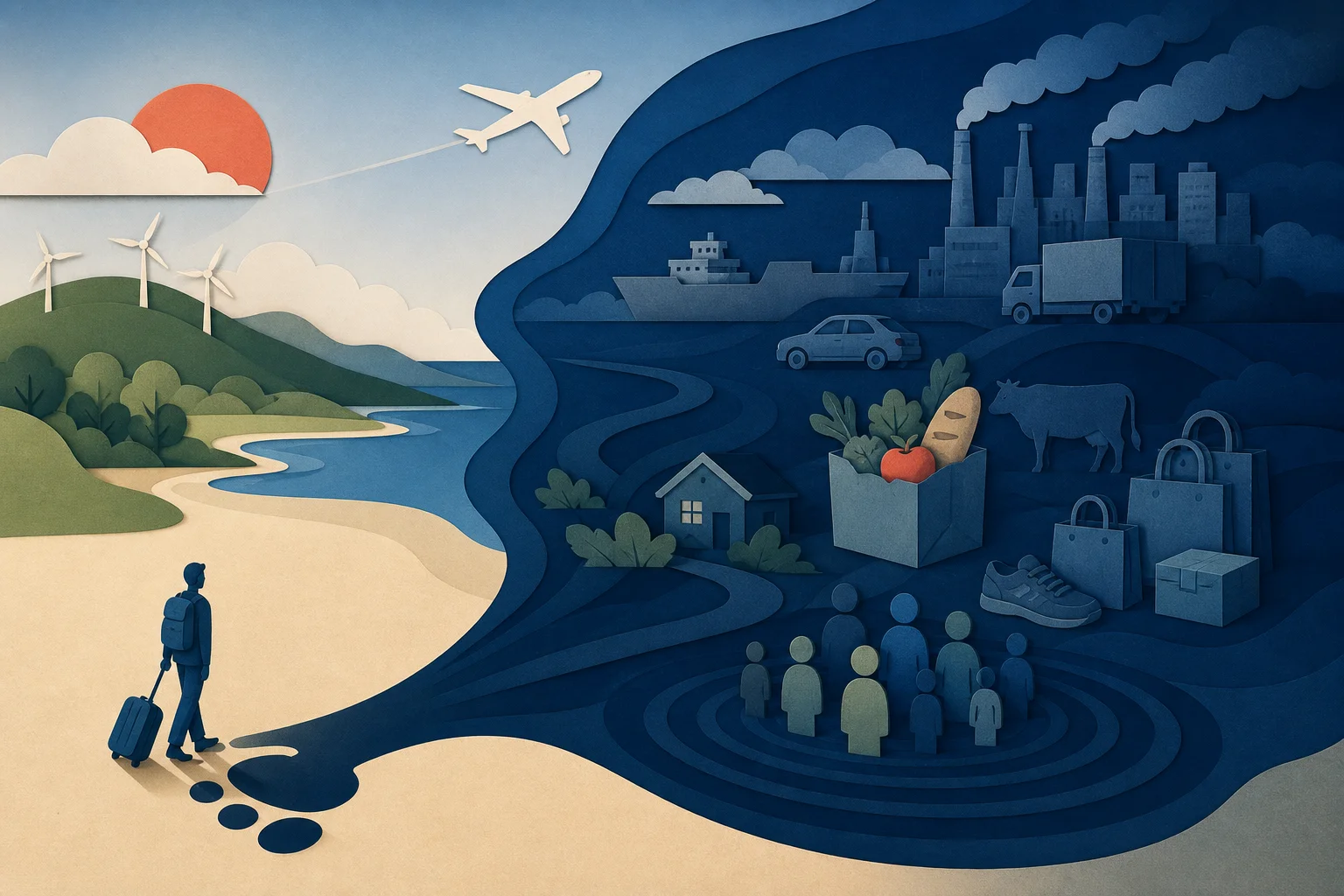
When it comes to the climate emergency, the tourism economy today faces some hard truths. Our carbon footprint is enormous – responsible for roughly 8% of the world’s global carbon emissions. But our carbon footprint is only one side of the story. In an article for MIC, climate journalist Emma Pattee coined the term ‘Climate Shadow’ to describe an individual’s potential impact on the climate, revealing how calculating carbon footprints alone doesn’t “paint an accurate picture of our true individual impact on the climate crisis.”
In summary, she revealed our calculated emissions from daily activities, such as transport and energy usage, don’t account for the wider, broader influence we might have in life, such as; choosing to work as a marketing professional for a climate mitigation technology company over an oil and gas company, banking with a provider that doesn’t invest in fossil fuels, or voting for political leaders with green policies. These choices have far-reaching, real-world impacts, but are simply unaccounted for in our carbon footprint calculations. These choices, and their impact, are our climate shadow.
So when it comes to the tourism industry, what differentiates our carbon footprint from our climate shadow? And more crucially, what opportunities does the concept of our climate shadow present to accelerate sustainable development in tourism ?
As I mentioned, current statistics on the global tourism economies’ carbon footprint don’t make for enjoyable reading. According to a Nature.com report, the top culprit for emissions, as you might expect, is Transport (49%), followed by Goods (12%) and Food and Beverage (10%). But while we can’t escape from the enormity of our impact on global warming, the ability to calculate and measure our emissions provides the basis for decarbonisation.
And there’s plenty of progress and reasons to be optimistic when it comes to the reduction of the sector’s carbon emissions. ABTA has reported that by modernising fleets, using alternative fuels and reducing waste, the global cruise industry is aiming to reduce emissions by 40% by 2030. The ReFuelEU aviation initiative is encouraging the uptake of sustainable fuels as part of the Fit for 55 legislation which aims to reduce emissions by a minimum of 55% by 2030. Tour operators Intrepid Travel and Exodus Travel have both committed to science-based targets to reduce both internal emissions and halve emissions per passenger. So while the data may be painful, it is also the springboard for real, tangible reductions and optimisations to lighten our footprint.
But while the positive action by the tourism industry is encouraging, reducing carbon emissions per passenger belies the truth that there are more and more passengers travelling each year. With the world’s population getting wealthier, travel demand is forecast to increase exponentially; tourism emissions are projected to reach 6.5 billion metric tons by 2025. That’s a 44% increase from 2013, far from the negative figures we need to ultimately lower the sector’s contribution to a warmer world. But here’s where casting our climate shadow might prove to be pivotal…
“Research in behavior change shows that a new context or environment makes people more open to adopting new ideas and behaviors. Considering that going on holiday is in itself a context change, how can the tourism sector leverage this to encourage the adoption of sustainable behaviors?”
It might not feel as tangible as our carbon footprint, but thinking about and addressing our climate shadow, as Patee reasons, could potentially have an even bigger, wider impact. Because while reducing our carbon footprint is about making calculated changes now, shaping our climate shadow is about creating long-term sustainable lifestyles and societies. By working with young people, and regularly having conversations with them about their own individual impact, I have seen why the concept of the climate shadow is so inspiring. Not only does it illustrate how the behavior of one person/business can have a positive impact – dispelling feelings of apathy and negativity that come from feeling too small to make a difference – the concept of climate shadow captures the impact of the ‘snowball effect’ that climate-positive behaviors can have.
So how could our climate shadow tackle tourism’s projected 6.5 billion metric tons of emissions? Firstly, it prompts us to look beyond immediate changes to consider our behavior and the true long-term impact of our decisions and actions. Secondly, it invites us to explore our capacity to influence change, in a business sense, but ultimately with our customers. What kind of effect could elevating local, sustainably-sourced food have on local livelihoods and supply chains? How could immersing tourists in cultural traditions promote a sense of cross-cultural connection and empathy? Research in behavior change shows that a new context or environment makes people more open to adopting new ideas and behaviors. Considering that going on holiday is in itself a context change, how can the tourism sector leverage this to encourage the adoption of sustainable behaviors?
Yes, the impact of this kind of behavior change is difficult to measure. It is not always easily quantifiable with the emissions data that proves beyond doubt that progress is, or is not, being made. For example, by encouraging young people to be responsible for energy consumption in a school building, we reduced the carbon footprint of the school, but as part of this initiative we had parents and grandparents explaining how the children were bringing their new responsible behavior home, and encouraging their seniors to take responsibility too! The reduced energy consumption of the school was easy to quantify. The wider implications of the influence children had on home energy consumption, less so. Yet this demonstrates what the concept of the climate shadow is all about — the impact of our behavior, and our choices.
For now, keep an eye on your carbon footprint, but find a moment to look beyond it and consider your climate shadow. What influential changes could you cultivate to shape it, and develop and motivate climate-positive behaviors?